Anyone who has participated in a law firm's website or brand design project knows that they can be complex and sometimes stressful. The top reasons include:
- They’re very expensive. So, there’s a lot at stake.
- It’s public. Everybody will see it, and everyone will judge the finished product.
- It’s creative. And it’s being supervised by non-creative people (lawyers).
Adding further complexity, the new design must also reflect the essence of the entire firm. For law firms that offer scores of services across dozens of industries, achieving this kind of broad consensus is no small challenge.
Strategies for a Stress-free Project
So, with all the challenges that must be addressed, how can a firm prevent a project from going wrong?
After nearly 25 years in the world of legal marketing, we’ve learned (through trial and error) that a strategy-first approach is the essential first step to a successful, stress-free branding project.
A strategy-first approach ensures that the project runs smoothly by eliminating the notion that any of the creative decisions might be arbitrary or based on personal preference. It doesn't matter if someone dislikes the color yellow, as long as that shade of yellow supports the agreed-upon objectives.
So, what does a strategy-first creative process look like? Below are the critical steps that help ensure success.
1. Identify Key Messages
This is the most crucial step in any website design or branding project, as it sets the stage for everything that comes next.
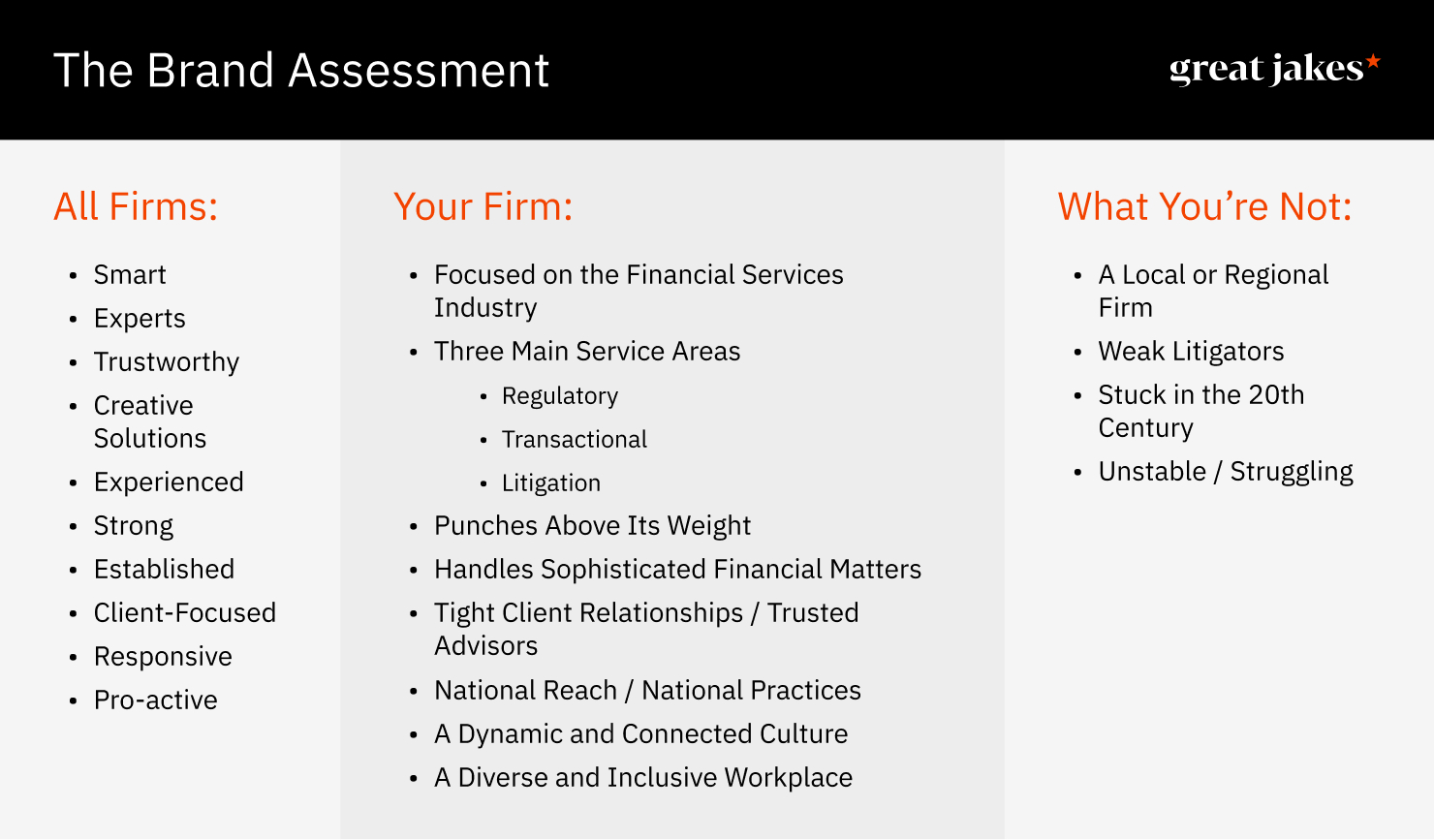
We recommend that you conduct a "brand assessment" to understand the key messages you need to communicate. The brand assessment exercise aims to answer one fundamental question: What makes the firm (as a whole) remarkable?
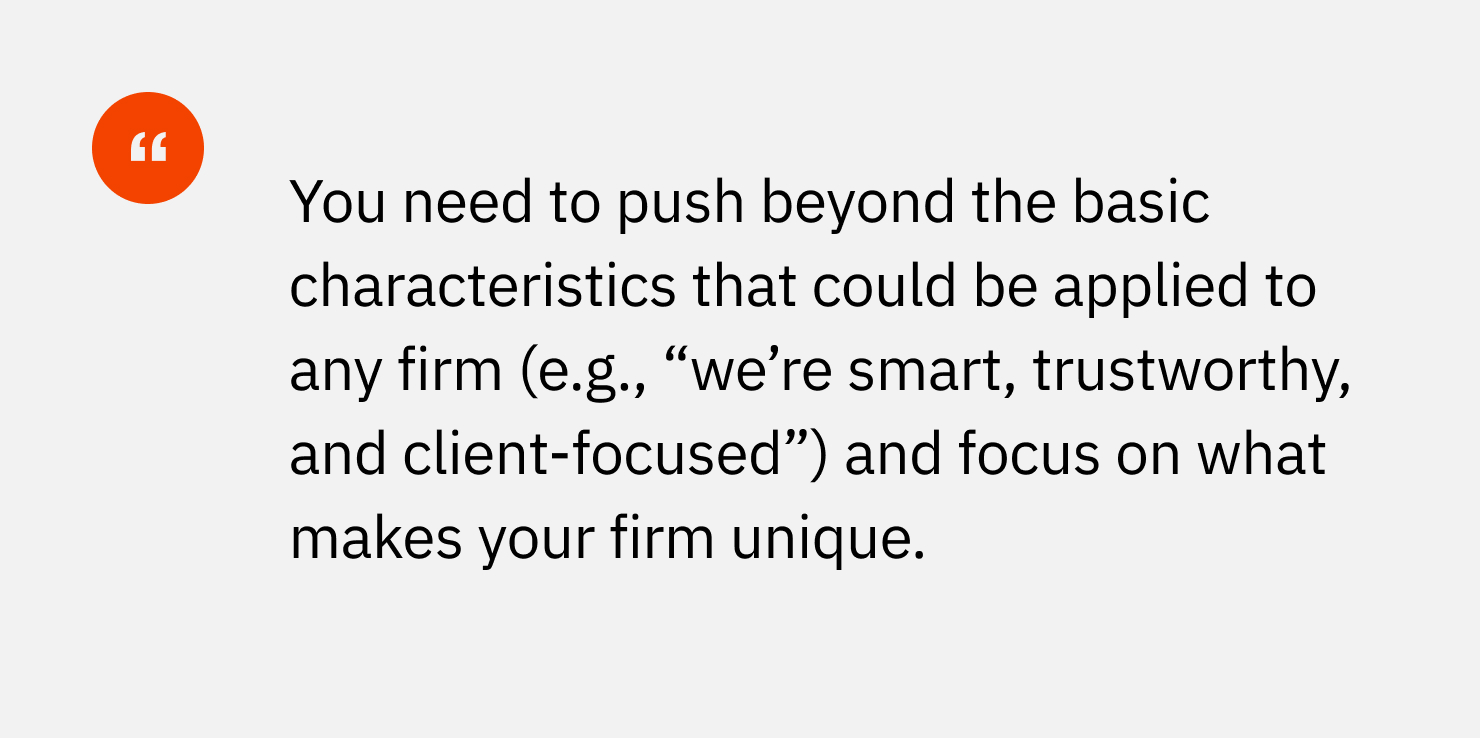
During the brand assessment, you need to push beyond the basic characteristics that could be applied to any firm (e.g., "we’re smart, trustworthy, and client-focused") and focus on what makes your firm unique when compared to competitors.
For example, your firm may have a unique geographic or industry focus. Another firm may have core services it would like to highlight or a specific type of client it aims to work with.
As part of the brand assessment, we also suggest identifying any misperceptions or possible negative perceptions that may exist in the marketplace. This can be very helpful, as it can align stakeholders behind a common communication goal (e.g., changing a specific negative perception of the firm).
Once you have a list of key messages, you should share it with your project stakeholders and allow them to weigh in before proceeding to the next step.
2. Write Project Objectives
With the results of the brand assessment in mind, begin writing a list of key project objectives. Start by asking: What are the most critical things this website needs to accomplish? Be as specific as you can.
A typical list of project objectives would include a series of bullet points like this:
- Position the firm as a nationwide law firm that can handle complex matters for Fortune 500 companies from coast to coast.
- Demonstrate the firm’s expertise in serving six key industries.
- Communicate that the firm is a nurturing and equitable workplace that attracts top talent and empowers people from diverse backgrounds to thrive.
Again, we recommend having your key stakeholders review the objectives, as their feedback about this will inform all future steps.
3. Develop Recommendations
With the project objectives in hand, you’ll be able to draft strategic recommendations. Obviously, the recommendations should all stem from the objectives. For example:
- If your objective was to dispel a misconception that the firm was old-fashioned, you might recommend that the website’s homepage include a slick page load animation and modern-looking imagery.
- If your objective was to dispel the misperception that your firm is a “boys club” and appeal to a more diverse group of clients and prospective employees, you might recommend that the firm modernize its old-school blue-on-blue color scheme.
- Suppose another objective was to re-position your firm as national (as opposed to the regional firm that you were a decade ago). In that case, you might recommend that the website’s homepage include an interactive map illustrating the firm’s geographic footprint.
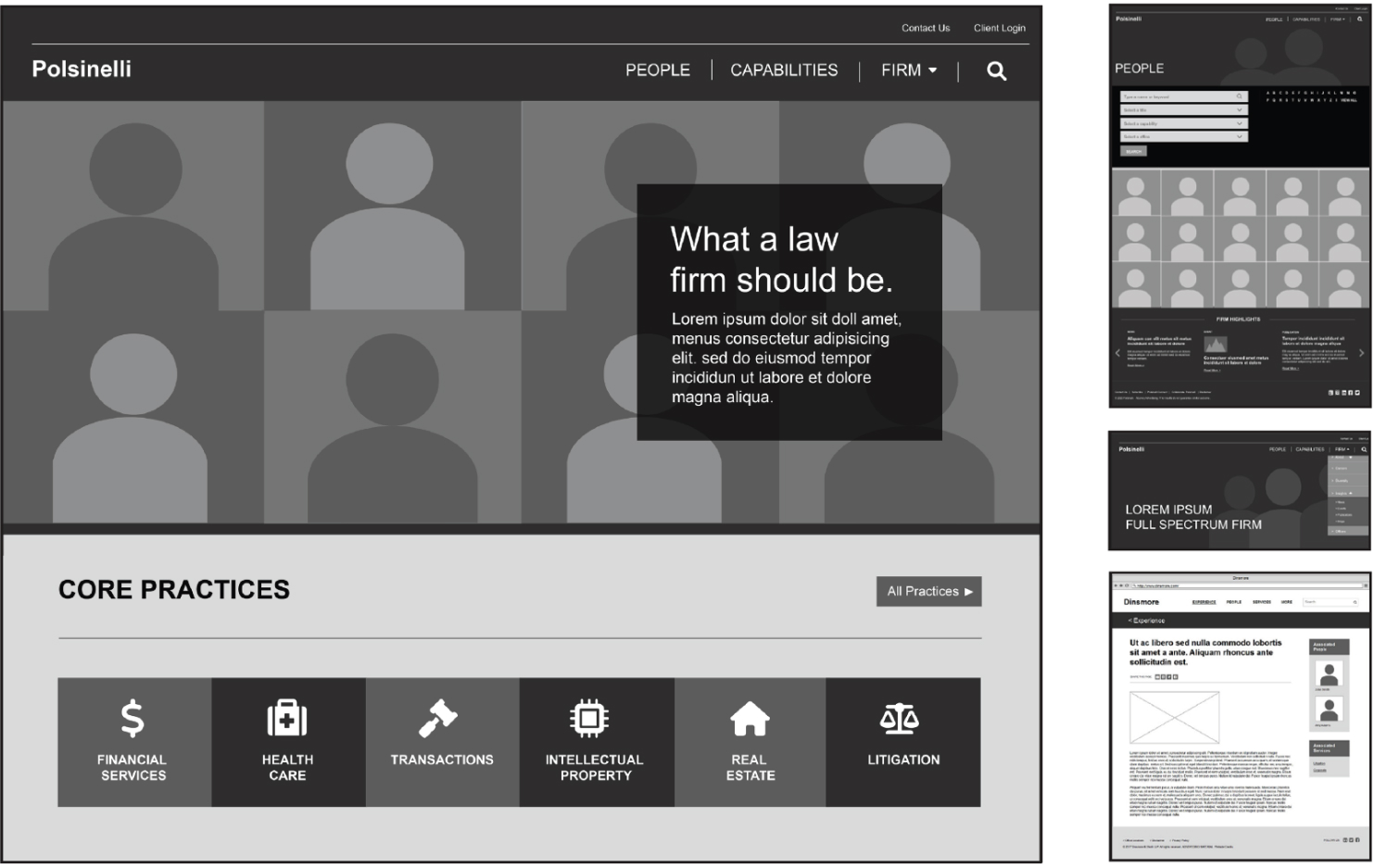
In addition to writing your objectives, we find it helpful to illustrate them. Creating preliminary wireframe diagrams of key site pages allows your stakeholders to visualize how the recommendations will manifest on the website. It also lets you ease your colleagues into critical aspects of the site’s design, such as how the navigation will work and what information blocks will be included on the homepage.
The Next Step: Design
A strategy-first approach sets the stage for a smooth design phase. By clarifying goals and providing detailed recommendations upfront, all stakeholders know exactly what needs to be designed—and why. With a shared vision in place, the design process becomes far less stressful, avoiding the confusion and conflict that often arise when visuals are introduced.
So, what does a drama-free design phase look like? We get into that in Part 2. Stay tuned.
About the Authors
Robert Algeri is a co-founder of Great Jakes, a strategy-first brand and website design agency that partners exclusively with growth-focused law firms. He helps firms clarify their positioning and translate it into modern digital experiences that differentiate them from competitors. Deeply involved in the legal marketing community, Robert is an active member of the Legal Marketing Association (LMA) and has served on a range of boards and committees. He also writes and speaks regularly on law firm branding, websites, and growth, including contributions to industry outlets such as the LMA’s Strategies magazine.
Dion Algeri is a co-founder and Creative Director at Great Jakes. For more than 20 years, he has helped shape modern legal marketing by translating a deep understanding of the legal marketplace into sophisticated digital experiences for law firms. He writes and speaks frequently on legal marketing, including contributions to the American Bar Association’s Law Practice magazine. Dion also serves as editor of the Great Jakes blog, where he shares practical insights on law firm branding and websites.