Attorney bios are the most important content on any law firm website. It’s safe to say that it’s impossible to have a great site without well-written bios.
So, what does it take to write an extraordinary bio? To answer this question, we turned to our friend Deb Scaringi, who authors thousands of them.
About Deb
 Deb has been marketing lawyers and law firms for over 25 years. To put that in perspective, she was working at Peabody & Brown in 1999 when it merged to become Nixon Peabody.
For nearly 20 years, Deb has been a consultant to law firms. Roughly half of her business is focused on writing marketing content (including countless bios). The other half is as a business development coach and trainer. She works with firms across the U.S., ranging from boutiques to global, multi-layered firms.
Incredibly important! Website bios are – without a doubt – the most important piece of marketing collateral a lawyer has at their disposal. Just take a look at the traffic data for any law firm website – you’ll find that the bio section is where visitors spend the most time. Their importance can’t be understated.
It’s at the top of the list! Prompted by a need, prospective clients ask for referrals. This often leads them to visit a lawyer’s bio so that they may compare them with the other attorneys their trusted network recommended. And, this all happens before the lawyer even knows they are being considered!
So, indeed, bios play an early – and really important – role in business development.
As a result, you need to put your best foot forward. Reality is, you never know when someone is checking your bio!
My advice is to give the reader what they need to know immediately. Analytics show we have very little time to capture someone’s attention, so I recommend you start with:
- what kind of lawyer you are
- who hires you
- what businesses/industries do you serve
This is information that a prospective client wants to know first, so put it up front. And use clear, direct language.
After communicating these introductory points, you can get into more detail about why you are the right person for the job.
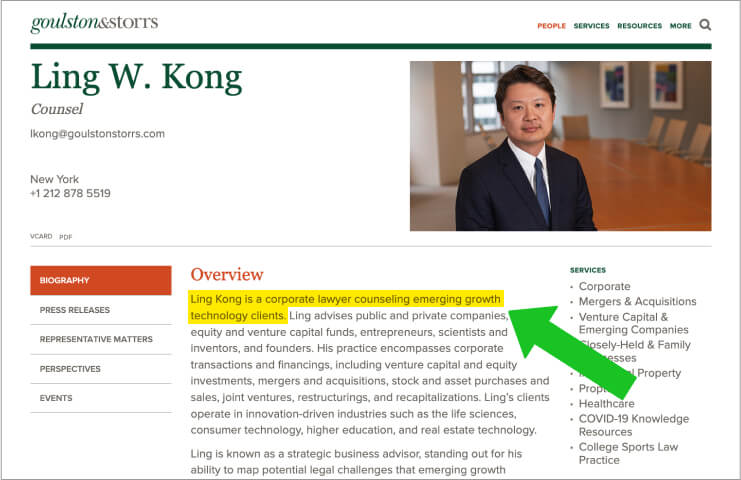
Take a look at the bio for Ling Kong, an attorney at Goulston Storrs. His first sentence is, “Ling Kong is a corporate lawyer counseling emerging growth technology clients.” This intro is purposefully concise – to quickly convey to readers what he does and for whom. More details come later about who he is and what he’s accomplished.
A classic pitfall is a message that’s too broad. Lawyers sometimes say that they do everything for everybody because they don’t want to rule out any type of work. In today’s business development environment, people want to know you have successfully solved their problem before. By trying to be everything to everyone, it’s hard for the prospect to decipher what an attorney is known for and then move on to someone else.
I think the best lawyer bios target their message to specific types of work. And that message should convey the type of work a lawyer wants to be doing while reflecting the kind of work the firm wants to attract.
Another mistake is falling for the temptation to “set the stage” with an introductory sentence or two (“In today’s highly regulated financial landscape, yadda, yadda, yadda…”). I think this is problematic for two reasons: SEO and losing the reader because it took too long to position the lawyer. In my opinion, a very direct approach works better.
I spend lots of time helping lawyers figure out how to position themselves and ways to communicate their story. To help them think it through, I start with three probing questions:
- Where do you offer the greatest value?
- What type of work do you enjoy most?
- How do the answers to 1 & 2 intersect with the needs of buyers?
Also, I love using representative matters. In my opinion, they are an essential ingredient to a great bio.
Some firms only include representative matters on the practice area pages of their websites. I think that’s misguided. They should appear on bios because that is where your traffic is going, and it also helps lawyers tell a compelling story about their experience.
Both work, but a one-sentence, brief bullet points may not tell the reader enough. Representative matters should include some meaty details, which typically require at least a couple of sentences.
For example, I try to include details such as the dollar size, geographic scope, or a unique feature about a deal or an outcome whenever possible. It also helps to describe the client in as much detail as you can, assuming you can’t use their name. These details will make the text much more interesting to a reader. The matters tab on Ling Kong’s bio contains some great examples.
I feel pretty strongly that lawyers should refresh their bios annually. Every six months would be even better. When I say “refresh” I mean making small adjustments – a sentence here, a representative matter there – to keep the information pertinent.
In reality, firm marketing teams run lean and often can’t retouch attorney bios unless the lawyer makes a specific request. But unfortunately, this leads to the bios becoming outdated over time. And then, when the firm responds to an RFP or overhauls the website, there has to be a huge push to rewrite the bios from the ground up. When reworking a website, refreshing content is a massive, time-consuming, and expensive task for any size firm. And it can be a huge bottleneck for launch. It’s much better to update the bios regularly (either internally or with the help of an outside writer) because it spreads departmental resources out over time while putting a lawyer’s best foot forward all the time.
Yes. Bios are becoming more casual and authentic. This trend has been happening for a while; however, it seems to have accelerated post-pandemic.
With people working from their homes more routinely, a more casual work environment has emerged. This has sparked a change in the general business culture. Gone are the days when people came to offices wearing power suits while masking their personal lives. People often attend Zoom meetings wearing fleece or a sweater and are conversing more casually. I find that this comfort is being reflected in the language of their bios. I think it provides an opportunity to show a personal style that supports more authentic relationships.
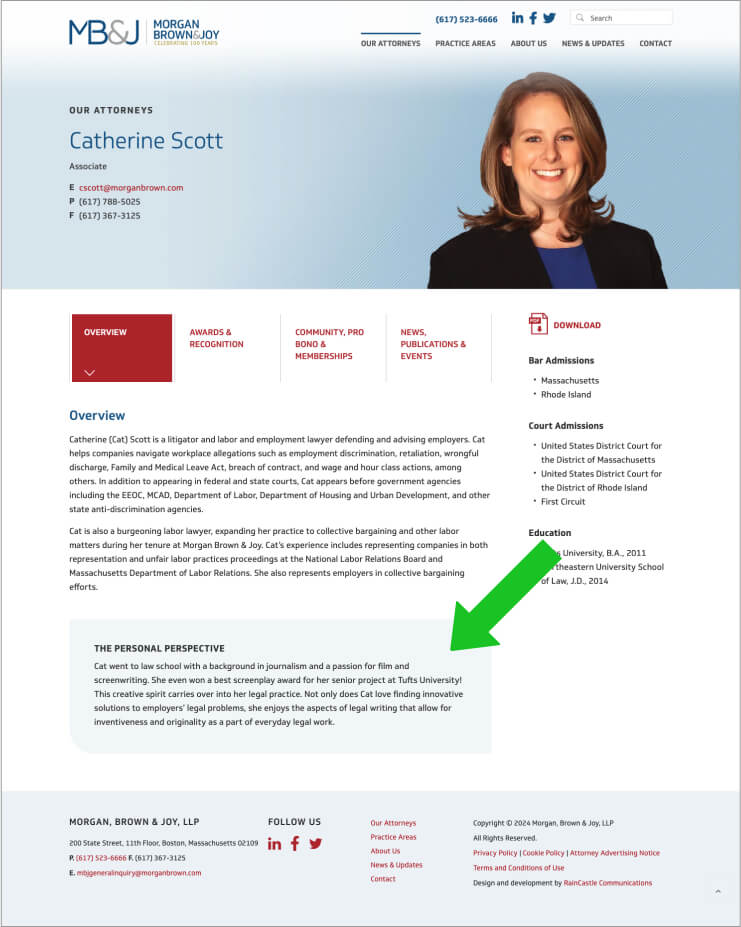
Check out Cat Scott’s bio at Morgan Brown. Her bio has a section called “A Personal Perspective.” In it, she mentions her passion for film and that she won the “best screenplay” award for her senior project in college. This is a great, unique tidbit.
I could totally imagine this prompting a conversation about her screenplay – and movies in general. Details like this open the door to a more personal and authentic dialog, which is great for nurturing relationships that lead to better business development results.
Yes. Don’t let lawyers write their own bios! They need to be building relationships and working on client matters. Besides, legal writing is different from marketing writing. My pet peeve… lawyers almost always use the passive voice when writing… something that should be avoided. Leave the bio writing to the professionals. It will pay off in the long run, I promise!
Deb Scaringi is a Legal Marketing and Business Development professional and a recent inductee of the Legal Marketing Association Hall of Fame.
To learn more about Deb, visit her website: Scaringi Marketing
About the Authors
Robert Algeri is a co-founder of Great Jakes, a strategy-first brand and website design agency that partners exclusively with growth-focused law firms. He helps firms clarify their positioning and translate it into modern digital experiences that differentiate them from competitors. Deeply involved in the legal marketing community, Robert is an active member of the Legal Marketing Association (LMA) and has served on a range of boards and committees. He also writes and speaks regularly on law firm branding, websites, and growth, including contributions to industry outlets such as the LMA’s Strategies magazine.
Dion Algeri is a co-founder and Creative Director at Great Jakes. For more than 20 years, he has helped shape modern legal marketing by translating a deep understanding of the legal marketplace into sophisticated digital experiences for law firms. He writes and speaks frequently on legal marketing, including contributions to the American Bar Association’s Law Practice magazine. Dion also serves as editor of the Great Jakes blog, where he shares practical insights on law firm branding and websites.