Every lawyer wants their bio to rank highly on Google. However, it’s often unclear how to achieve this goal (or whether it’s even worth the effort). And the rise of AI answer engines (like ChatGPT) has introduced a new dimension to search engine optimization (SEO), thereby adding to the confusion.
To help us navigate these complexities, we reached out to our friend Joe Giovannoli, a search marketing expert.
About Joe Giovannoli
 Joe knows SEO. He also knows a thing or two about legal marketing, having served over 100 law firms.
Joe Giovannoli is the Founder and CEO of 9Sail, a search marketing firm focused on the legal industry. Established in 2015, 9Sail law firms use SEO to generate targeted website traffic that leads to conversions. 9Sail’s clients range from smaller regional firms to some big names in the AmLaw 100.
Every seasoned legal marketer knows that hands-down, bios are among the most important—and highly trafficked—pages on a law firm’s website. Bios are often the final stop people make before picking up the phone or sending an email. So, bios should always be on top of the priority list for legal marketers.
As for SEO on bios, you really can’t separate SEO from other aspects of marketing. SEO is important, but it is all part of the same marketing effort.
It’s important to move the focus away from the traditional metrics of “clicks and traffic.” Clicks and traffic don’t pay the bills. This is an outdated way of thinking.
Instead, focus on conversions. This is about prompting people to reach out and start a one-on-one dialog (after they’ve looked at your bio). Google plays a part in this process by sending traffic to your bio page. But that’s just the beginning. If a bio is awful, it won’t convert. Being listed #1 under “Bankruptcy Law in Des Moines” won’t mean much if the person’s bio is awful and outdated and isn’t able to convert.
Again, you can’t entirely separate good marketing and good SEO. Back in the old days, you could use keyword stuffing and other techniques to trick Google into ranking you highly. Those days are over.
Now, Google evaluates the value of content based on EEAT: Experience, Expertise, Authority, and Trustworthiness. If you successfully follow Google’s guidance on EEAT, you’ll have an engaging, information-rich bio that will convert. And Google will rank it highly.
The first 200 words are the most vital—hit them with the most important aspects of your practice right out of the gate. This is where Google is going to primarily pull from.
The following paragraphs in the bio should help validate and communicate what the attorney is really good at. It doesn’t need to be heavy on accolades. But it should—and the Great Jakes platform does this really well—provide plenty of substantiating content like cases and articles and such.
Also, I'm a big believer that the last paragraph or two should be about the lawyer’s life outside of the office.
People buy services from people they know, like, and trust. After reading your bio, a prospective client should feel like they can connect with you on a human level.
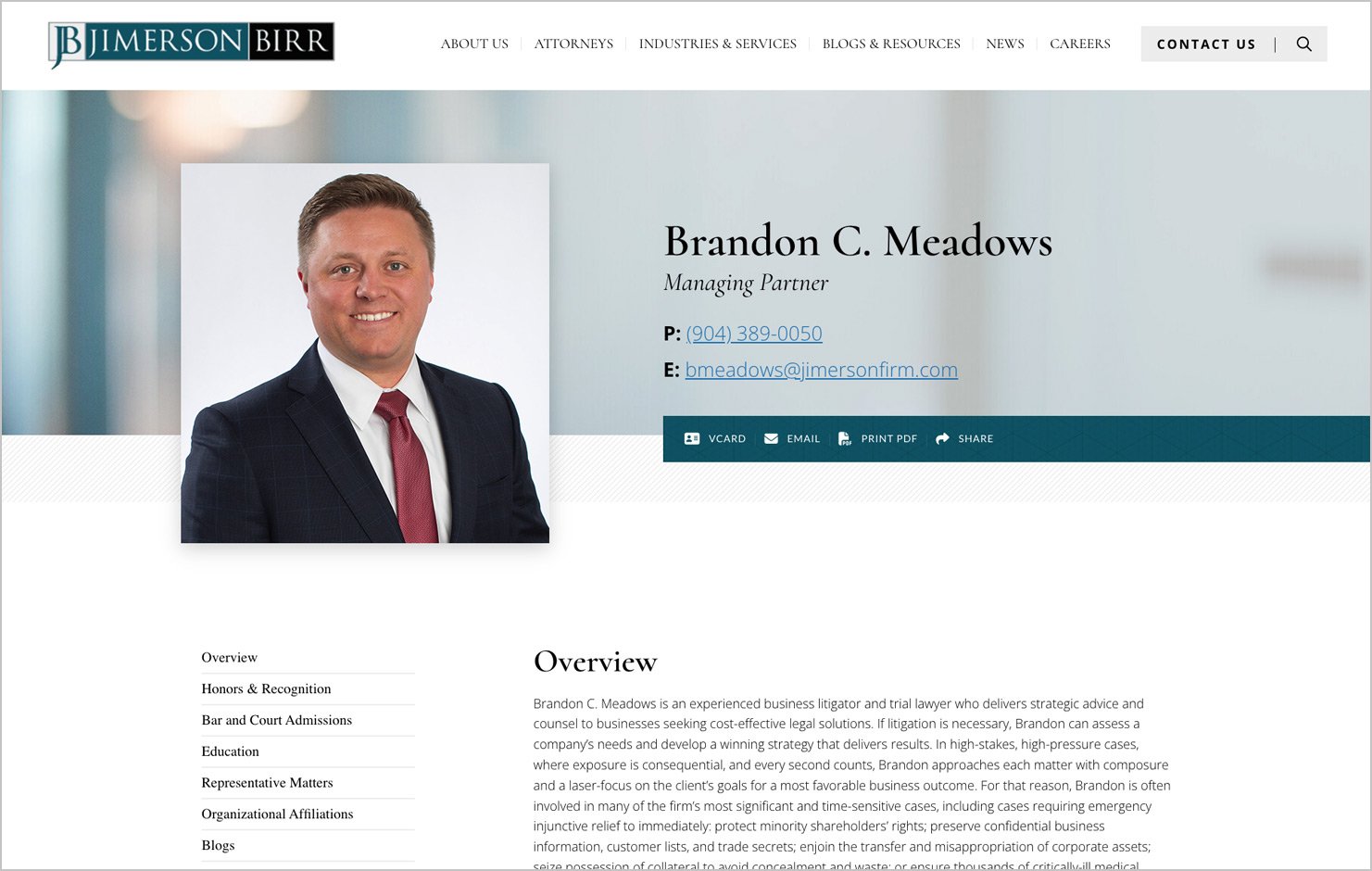
Check out Brandon Meadows’s bio on Jimerson Birr's website. First off, it’s really well-written. The first paragraph tells you exactly what he does. That’s followed by information about his clients and areas of expertise.
But the last part of his bio is the most memorable. He shares a bit about his family and their dog, Peanut, and how he enjoys “guitar jam sessions, beach getaways, taking his boys to the driving range, dancing with his little princess, and rooting for his Kentucky Wildcats (Go Big Blue!).”
I recently had an occasion to speak with Brandon—and we spent 30 minutes talking about the things in that paragraph before we got down to business. It turns out that we had lots in common, and by including those personal tidbits, he opened the door to a memorable conversation.
Bios that are too short. This is the number one issue.
I’m shocked when I see a bio with just 3 or 4 sentences. You can't sum up somebody's life and career in 3 or 4 sentences, right? And it’s not enough for Google either.
It’s still early days, but increasingly, people are going to ChatGPT or Perplexity and asking questions like, “What can you tell me about XYZ attorney?” These answer engines pull from multiple sources to create a narrative.
But the truth is that – for most lawyers – there aren’t many sources for AI to pull from. Their primary sources are your firm’s website bio and LinkedIn profile. So, you can often have a tremendous amount of control over what AI says about you by carefully crafting your bio.
Here's a pro-tip: Don’t just copy and paste your bio into your LinkedIn profile. Each location should contain unique information, giving the answer engines more to choose from.
Absolutely. The SEO basics—like title tags, alt text, URL slugs and meta descriptions—are all requirements for good SEO. Additionally, Schema markup – which helps Google understand the information—should be implemented. There are specific Schema tags for bio information.
While none of this is rocket science, there is a right way and a wrong way to apply all of these basics. So, I recommend that firms consult with a professional.
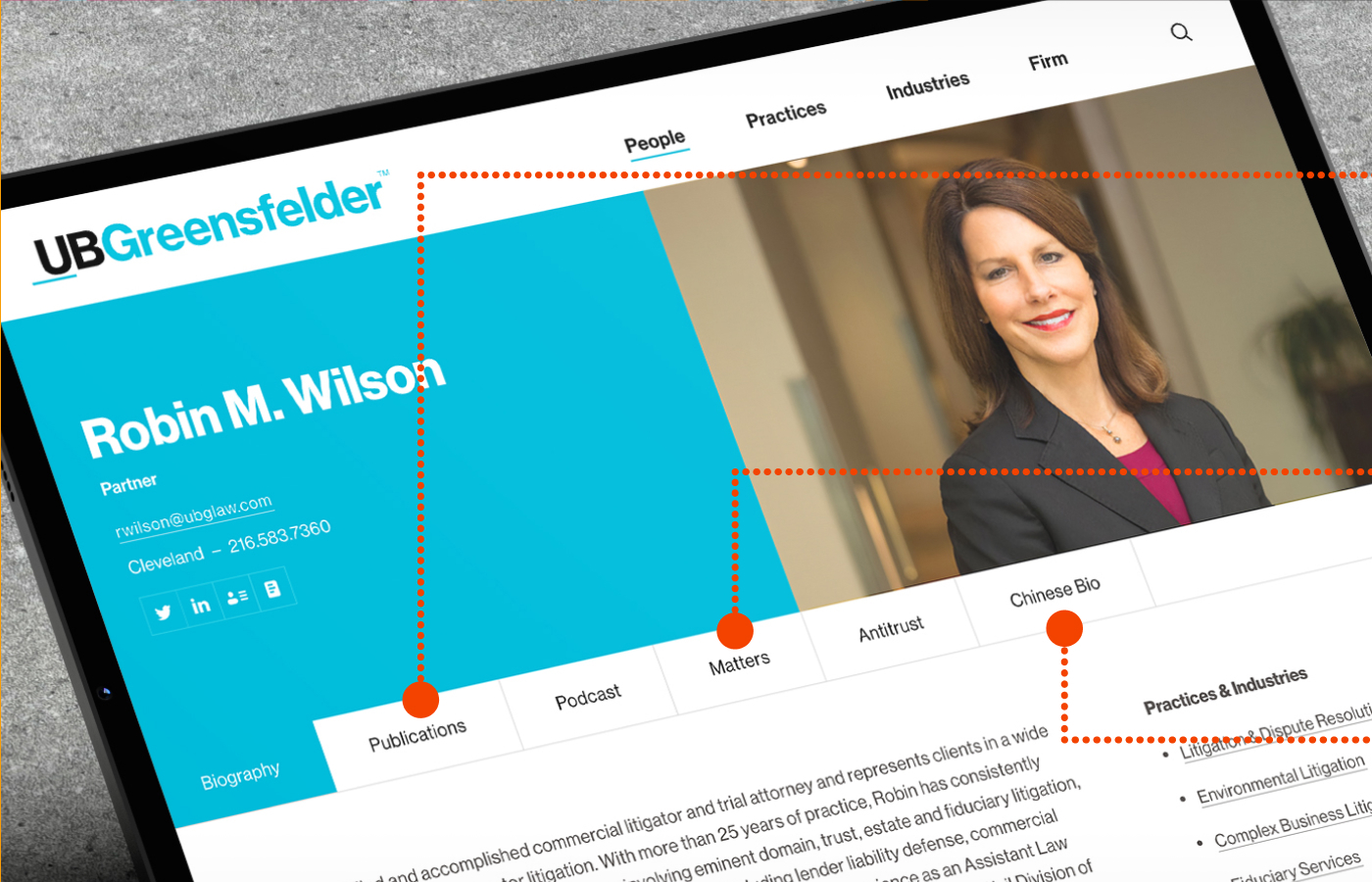
Another thing that’s important but sometimes gets overlooked is to tag or somehow relate the attorney to their practice groups and industries they serve. I like how Great Jakes does this by placing these in the margins at the top of the bio—so much better than at the bottom where it’s more difficult for users and search engines to find.
Definitely consider video. 30-, 60-, or 90-second videos are a great way for attorneys to share about themselves, and they’re good for Google, too.
Video has been climbing up the importance ladder of search for a while. It can definitely benefit a lawyer in terms of searchability and Google rankings.
But just like with writing, we advise that firms invest the time and money in getting professional videos made for their attorneys. Sometime poorly-produced videos can do more harm than good.
Yes. Don’t have AI write your bios. People will be able to tell, and so can Google. And don’t let lawyers write their own bios. It will end up sounding like a legal brief.
To get the best results, hire a professional to interview the attorney and create something remarkable.
And be sure to keep it real. It will reflect better on the firm and resonate better with your website visitors. And Google will like it too.
About the Authors
Robert Algeri is a co-founder of Great Jakes, a strategy-first brand and website design agency that partners exclusively with growth-focused law firms. He helps firms clarify their positioning and translate it into modern digital experiences that differentiate them from competitors. Deeply involved in the legal marketing community, Robert is an active member of the Legal Marketing Association (LMA) and has served on a range of boards and committees. He also writes and speaks regularly on law firm branding, websites, and growth, including contributions to industry outlets such as the LMA’s Strategies magazine.
Dion Algeri is a co-founder and Creative Director at Great Jakes. For more than 20 years, he has helped shape modern legal marketing by translating a deep understanding of the legal marketplace into sophisticated digital experiences for law firms. He writes and speaks frequently on legal marketing, including contributions to the American Bar Association’s Law Practice magazine. Dion also serves as editor of the Great Jakes blog, where he shares practical insights on law firm branding and websites.